This video from Hold Your Horses is just teeming with art history references, and they’re great!
Good job L’Ogre.
70 Million by Hold Your Horses ! from L'Ogre on Vimeo.
[Via panic attack.]
This video from Hold Your Horses is just teeming with art history references, and they’re great!
Good job L’Ogre.
70 Million by Hold Your Horses ! from L'Ogre on Vimeo.
[Via panic attack.]
Just came across the weBlimp, a crowd controlled telepresence device.
The concepts behind it are really cool.
Collaborative learning: “positive results of collaborative learning may be the notion that peer interaction stimulates elaboration of conceptual knowledge. In a collaborative learning situation, students must negotiate goals, represent problems and understand the meaning of concepts and procedures. Collaborative students have to make their thoughts explicit.”
Ludic interaction: “Ludic activities are motivated by values of curiosity, exploration, surprise, wonder and reflection rather than by externally defined tasks. These values stimulate the intrinsic motiviation to interact with a design or to say it short feed the desire to play.”
Their results (and basic interface) remind me a lot of my piece Tangolumen. One thing though, I think that their results are a bit generous. In their video the narrator says “…participants were eager to interact with, not just the control space, but also with the blimp itself…” But of course the participants in the prototyping phase were friends, classmates, and colleagues. These are people that are eager to play with everything you make, which while a real blessing, doesn’t make it the best gauge for interactivity. I’ll be eager to see how the blimp fares when it is at the Surrey 2010 Celebration site in Holland Park during 2010 Winter Olympic Games from Feb. 17-21.
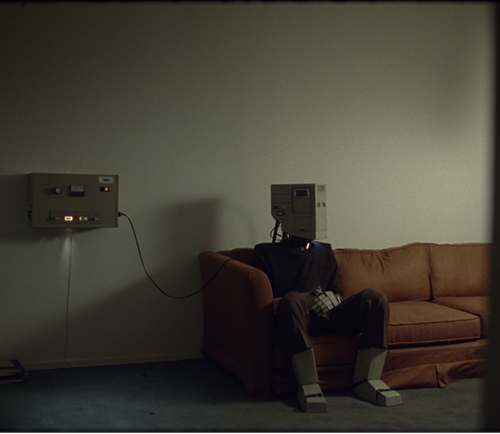
Ok, I’m in love with this short film already. And I haven’t seen it yet. It premiered last night as part of the first-ever Opening Night’s Shorts Program at the Sundance Film Festival. But for those of us not at the festival, it’ll premier on www.imheremovie.com in March. Continue reading
Gentleman, Scholar, and friend to all (and comic artist / world adventurer) Ryan Estrada is making a movie.

Specifically he’s making a 90 minute (aka feature length!) animated film based on his comic “The Kind You Don’t Take Home To Mother.”
The Kind You Don’t Take Home to Mother is an upcoming independent animated feature directed by Ryan Estrada. It’s a movie about a werewolf, but with one small difference. It takes place between full moons.
With four weeks of freedom until her next transformation, Julia Hobson faces a whole new set of horrors. First dates, disapproving parents, awkward social situations, and the looming lunar deadline that makes her wonder if her new relationship will last the full moon.
It’s only a matter of time before David Duncan finds out if Julia really is the girl of his dreams, or if life with a lycanthrope turns out to be too much to handle.
And you know what the coolest part is?
YOU can be in it. (Or your dog can be in it.) How freaking cool is that? All you have to do is help with the funding and in exchange you (or your dog) will be animated into it.
Check out the movie’s site and if (I mean when) you decide you’re into it, help make it happen. Because it’s going to be awesome, and you can be part of it.
While in Eugene this weekend setting up some art in a gallery installation, I found myself writing a piece of applescript to load a video, loop it, and place it in full screen whenever the computer booted up.
Then I encountered a small problem: when it loaded, the computer was placing the mouse cursor in the upper left corner of the screen, keeping the file menu visible, despite the full screen video.
Not wanting to make extra work for the gallery manager, I decided to solve the problem through applescript.
Now, there is not a direct command in applescript to control the mouse (which is a bummer, as that would have been incredibly easy.) but there is a way to emulate keystrokes. This is enough.

Michael Vorfeld: Light Bulb Music from Norman Liebich on Vimeo.
Artist Michael Vorfeld created an audio installation from the sounds of lights being turned on and off.
It’s very beautiful. I’m only a little disappointed that there isn’t more of a tonal range between the bulbs. (Also a little surprised that the sound is more of a ding than a hum.)
Still, I wish I’d thought of it first.
I was talking with Colin Ives the other day, asking what exactly had convinced me to help one of his students, Kate Sessions, so much with a piece she was working on. (Honestly, I love helping other artists overcome technical bumps, but it was a point of conversation.)
He just looks at me and points out “you’re obsessed with light matrixes.”
And he’s right. Which is why when I saw this interactive piece by Gebhard Sengmüller, I almost peed a little.
“A Parallel Image” is an electronic camera obscura. This media-archaeological, interactive sculpture is based on the fictive assumption that the currently still valid principle of electronically transmitting moving images, namely by breaking them down into single images and image lines, was never discovered. The result is an apparatus that attempts a highly elaborate parallel transmission or every single pixel from sender to receiver. This is only possible by connecting camera and monitor using about 2,500 cables. Unlike conventional electronic image transmission procedures, “A Parallel Image” is technologically completely transparent, conveying to the viewer a correspondence between real world and transmission that can be sensually experienced.
[Via Make]
Mrs Eaves (aka Gemma O’Brien) attended TYPO Berlin, with a lovely piece of performance text.
There have been a lot of magazines doing the whole text covered model things, and of course there are several really famous pieces by Sagmeister, but that is then distilled back into a 2D context for consumption (the magazine cover). I think taking body text out into the world adds a whole other, much more interesting, level to the art experiment. Bringing with it both spectacle and ambiguity.
I’m also posting an interview with Mrs Eaves from the expo that I’m wildly entertained by mostly because it starts with type related questions, and then delves into questions about Star Wars. Why? I don’t know, and I think she was equally confused. (The intro is in German, but the interview is in English.)
[Via For The Love Of Type]